# CumulativeVariance
The **CumulativeVariance** function calculates the variance of a column up to and including the current row value.
### Syntax
```
CumulativeVariance([field])
```
Function argument:
| | |
| --------- | ------------------------------------------------------------- |
| **field** | The column to reference when calculating cumulative variance. |
> ### 📘Cumulative functions depend on the order of the given column. If you change the sorting you will change the result.
### Example
```
CumulativeVariance([Close Price])
```
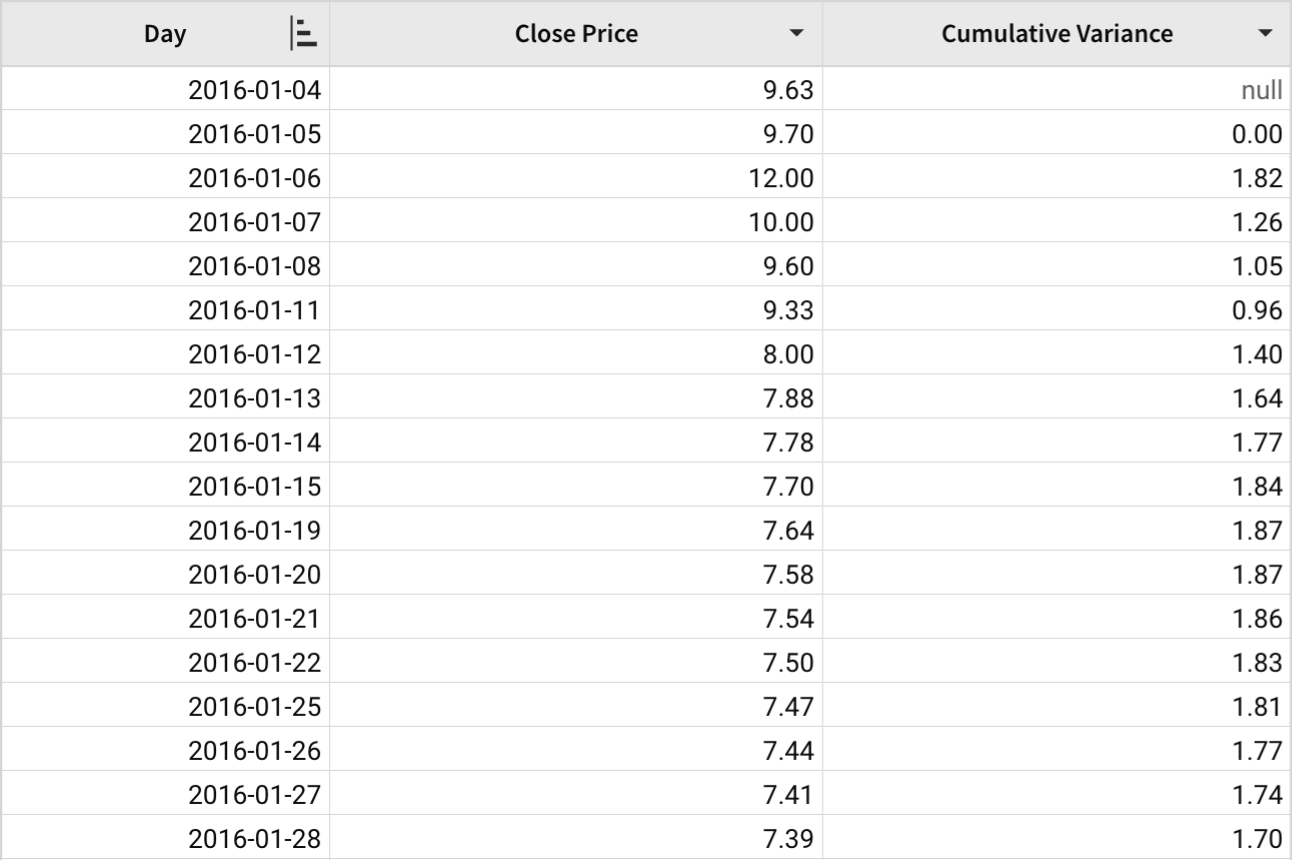
A table contains the daily close price of a stock in 2016. Variance can be used to show the volatility of a stock, where a higher variance indicates higher risk. We can use the **CumulativeVariance** function to identify the change in variance over time.
---
# Agent Instructions: Querying This Documentation
If you need additional information that is not directly available in this page, you can query the documentation dynamically by asking a question.
Perform an HTTP GET request on the current page URL with the `ask` query parameter:
```
GET https://support.meetuma.ai/uma-knowledgebase/data-and-reporting/analytics-pro/functions/window-functions/cumulativevariance.md?ask=
```
The question should be specific, self-contained, and written in natural language.
The response will contain a direct answer to the question and relevant excerpts and sources from the documentation.
Use this mechanism when the answer is not explicitly present in the current page, you need clarification or additional context, or you want to retrieve related documentation sections.